Origin Story · अग्रेयों का इतिहास
Agroha
अग्रोहा — हमारी उत्पत्ति
The city that produced the Aggarwal community — and the king who chose compassion over conquest, the merchant's scale over the warrior's sword.
The name · नाम का अर्थ
Who are the Agreya?
Whether your family surname is Aggarwal, Agrawal, Agarwal, Agrahari, Agrasen, Agrawala — or any of its twenty regional spellings — every one of them traces to the same Sanskrit root: Agreya, meaning the people of Agrey.
Name evolution across 2,000 years
The Agreya Janapada — the ancient kingdom of Agrey — is the source. Janapada means “a settlement of people with their own laws and governance.” The Agreyas were not just subjects of a king; they were citizens of a republic built on trade, non-violence, and mutual aid.
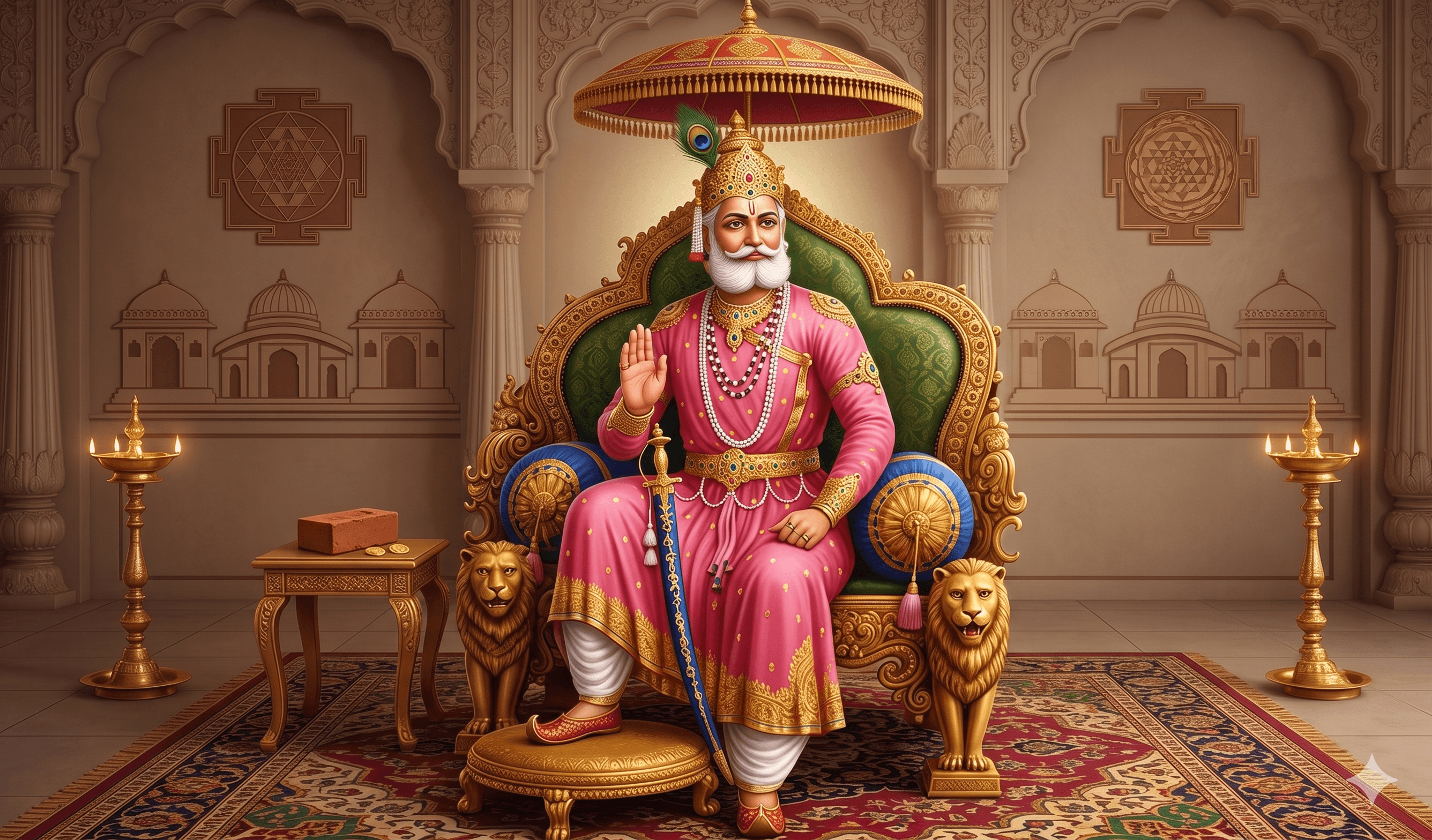
The founder · संस्थापक
Maharaja Agrasen
महाराज अग्रसेन
Maharaja Agrasen was a Suryavanshi (Solar dynasty) Kshatriya king — a warrior by birth, trained in the arts of combat and statecraft. His lineage traced to the Sun itself, the highest of the Kshatriya bloodlines.
He ruled the Agreya Janapada in the northern plains — a fertile territory between the Sarasvati and Ghaggar rivers in what is now Haryana. Under his reign, Agroha became a centre of commerce; he is said to have performed seventeen Ashwamedha Yajnas, each marking a year of peace, prosperity, and expanding trade.
The eighteenth would be different.
The turning point · महापरिवर्तन
The Eighteenth Ashwamedha
अठारहवाँ अश्वमेध
The Ashwamedha Yajna — the horse sacrifice — was the ancient Kshatriya assertion of sovereignty. Seventeen times Agrasen had performed it, each time affirming his kingdom's dominion and prosperity. The eighteenth was underway.
As the ceremony reached its culmination, Agrasen looked at the horse prepared for sacrifice. The animal was trembling in fear — its eyes wide, its body rigid, every muscle pulled tight against the rope.
In that moment, tradition records, a profound sense of ahimsa descended on the king. He saw in the horse's terror a mirror of all the violence that sustained the warrior's path — every battle, every conquest, every assertion of power by force over the powerless.
“A kingdom sustained by blood is spiritually hollow. I renounce the sword for the scale.”
He halted the ceremony mid-ritual. He released the horse. He declared that his descendants would never again engage in animal sacrifice — and that the community he founded would be governed not by military might, but by honest commerce, non-violence, and mutual prosperity.
This is why the 18th gotra — Goyan — holds a distinct place in tradition: it traces to the very sacrifice that was stopped, the pivot moment when the Kshatriya warrior became the Vaishya merchant.
The republic · वणिक गणराज्य
Vanika Dharma — A New Order
वणिक धर्म — व्यापार, अहिंसा, समानता
Agrasen did not simply stop a sacrifice. He constituted a new civic order for Agroha — a proto-republican economy built on three founding principles.
Ek Rupaiya, Ek Eint
एक रुपया, एक ईंट
Every established household in Agroha was required to give each new immigrant one brick and one silver coin. The brick to build a home; the coin to start a business. No family would ever be penniless in Agroha. Wealth was not inherited but constitutionally guaranteed at the point of arrival.
Ahimsa in Trade
व्यापार में अहिंसा
Commerce in Agroha was strictly governed by non-violence. Trade in goods requiring animal slaughter or environmental destruction was formally discouraged. The merchant's vow — rooted in the same moment Agrasen released the horse — became an ethical code that Aggarwal traders carried across the subcontinent.
Democratic Governance
लोकतांत्रिक शासन
The 18-gotra system was designed as a federation. Each gotra head — representing one of Agrasen's 18 sons and their lineages — held equal voice in the state's governance. No single clan could dominate. It was, in modern terms, a merchant republic with constitutionally distributed power.
The lineages · वंशावली
18 Sons, 18 Gotras
अठारह पुत्र, अठारह गोत्र
Maharaja Agrasen established 18 state units — one for each of his 18 sons. Each son governed his janapada under the Vanika Dharma principles; over generations, the descendants of each son became a distinct gotra, carrying the family name forward. The sage assigned as the lineage preceptor (rishi) of each gotra gave it its spiritual authority.
The 18th gotra, Goyan, holds a distinct place: it traces to the moment the 18th Ashwamedha was stopped mid-ritual — the very act of renunciation that constituted the Vanika Dharma. Some traditions therefore count it as a “half gotra” or a gotra apart, its origin in a ceremony that was consciously, deliberately left incomplete.
Historical record · ऐतिहासिक प्रमाण
The Agreya Janapada in History
Traditional dates for Agrasen are mythological (c. 3000 BCE). The existence of the Agreya Janapada as a historical polity is independently attested by three classical sources from the 4th century BCE to the 13th–14th century CE.
Panini — Ashtadhyayi
c. 4th century BCE · Sutra 4.1.171
The Sanskrit grammarian Panini catalogued the peoples and republics of the Indian subcontinent in his Ashtadhyayi. In sutra 4.1.171 he names the Agreya (also rendered as Agrodaka) — identifying them as a Janapada that issued its own coinage. The later commentary Kashika Vritti clarifies that their capital was called Agrodaka — the Sanskrit name for Agroha.
This is the earliest datable attestation of the Agreya polity — placing them as a recognised, coin-issuing republic in the 4th century BCE, contemporary with the Nanda Empire.
Mahabharata — Vana Parva
Chapter 254 (Nakula's Digvijaya)
During Nakula's western conquest (Digvijaya) — his campaign to subjugate the kingdoms of the northwest — the Agreyas are listed among the clans he encountered. The Bhishma Parva separately names them among the tribes participating in the Kurukshetra war.
ततः शूलिनमासाद्य राज्ञः पुत्रं महाबलम् ।
अग्रेयान् प्रतिविन्ध्यांश्च जिगाय कुरुनन्दनः ॥
“Then, reaching the powerful son of the King (Shulin), the son of Kuru (Nakula) conquered the Agreyas and the Prativindhyas.”
Mahabharata, Vana Parva Ch. 254, Shloka 20
The Agreyas appear here as a powerful northern clan — significant enough to be named alongside the Prativindhyas in the great epic's account of the northwestern kingdoms.
Archaeological Coins — Agroha Mound
Excavations 1938–39 · Hisar, Haryana
The 1938–39 excavations at the Agroha mound (near Hisar, Haryana) unearthed 51 silver coins inscribed:
These are coins issued in the name of the Agreya republic. The mound shows continuous occupation from the 3rd–4th century BCE through the 13th–14th century CE — a 1,600-year span of settlement that ends precisely when the historical record shows Muhammad of Ghor's campaigns through the region.
Subsequent surveys by IIT Kanpur (GPR survey, March 2024) and the ASI (excavation season 2024–25) have expanded our understanding of the site. See Agrohadham for the current redevelopment.
The dispersal · विस्थापन
The Fall of Agroha — 1194 CE
Agroha flourished for over a millennium as a trading centre. Then, in 1194 CE, Muhammad of Ghor's campaigns through the northern plains reached the city. The destruction was total: the coin-issuing republic, the merchant quarter, the community infrastructure — all dismantled.
The Agreyas dispersed across the subcontinent. Carrying their trade skills, their gotra identities, and the memory of Vanika Dharma, they settled across Punjab, Rajasthan, Uttar Pradesh, and Malwa. Established merchant families became the commercial backbone of every major city they settled in.
Over the following eight centuries, regional dialects reshaped the name: Agreya became Agrey, then Agroheya, then the twenty regional spellings we carry today. The city was gone. The community survived — and thrived.
The physical site of Agroha was never forgotten. By the 20th century, efforts to reclaim and honour the ancestral homeland began — culminating in the Agrohadham temple complex and, today, a ₹100-crore ASI-supported heritage circuit being built on the original mound.
आरती · Devotion
Agrasen Maharaj ki Aarti
अग्रसेन महाराज की आरती
जय श्री अग्र हरे, स्वामी जय श्री अग्र हरे।
कोटि कोटि नत मस्तक, सादर नमन करें॥
आश्विन शुक्ल एकं, नृप वल्लभ जय।
अग्र वंश संस्थापक, नागवंश ब्याहे॥
केसरिया ध्वज फहरे, छात्र चंवर धारे।
झांझ, नफीरी नौबत बाजत तब द्वारे॥
अग्रोहा राजधानी, इंद्र शरण आए।
गोत्र अट्ठारह अनुपम, चारण गुंड गाए॥
सत्य, अहिंसा पालक, न्याय, नीति, समता।
ईंट, रुपए की रीति, प्रकट करे ममता॥
ब्रह्मा, विष्णु, शंकर, वर सिंहनी दीन्हा।
कुल देवी महामाया, वैश्य करम कीन्हा॥
अग्रसेन जी की आरती, जो कोई नर गाए।
कहत त्रिलोक विनय से सुख संपत्ति पाए॥
जय श्री अग्र हरे, स्वामी जय श्री अग्र हरे।
कोटि कोटि नत मस्तक, सादर नमन करें॥
Traditional community aarti — recited at Agrasen Jayanti and family celebrations.
Go deeper
Continue exploring
Agrohadham
अग्रोहाधाम
The temple complex being built today at the original Agroha site — three shrines, the 41-river Shakti Sarovar, and the new ₹100cr Adya Mahalaxmi temple.
Agra Bhagwat
अग्र भागवत
The Srimad Agrabhagavatam — the modern Aggarwal community scripture compiled from 216 bhojpatras, telling the Agrasen narrative in 1,429 shlokas.
18 Gotras
अठारह गोत्र
The full mandala of the 18 gotras — their founding rishis, Vedic associations, and your family's place within the lineage.
Your family's chapter of this story
इस कहानी में आपके परिवार का अध्याय
Every Aggarwal family is a continuation of the Agreya story. Map your branch of the tree — your gotra, your ancestral village, the generation that left Agroha — and connect it to the heritage that runs back 2,000 years.