Community Heritage · सामुदायिक विरासत
The Aggarwal Timeline
अग्रवाल इतिहास
From Maharaja Agrasen and the kingdom of Agroha, through the medieval fall and dispersal, the colonial trading houses, and the global diaspora of today — a community history older than most living civilisations.
Traditional dates come from the Agrasen Purana and oral history. Where the historical record is firm (e.g. the 1194 CE fall of Agroha) we use the documented year.
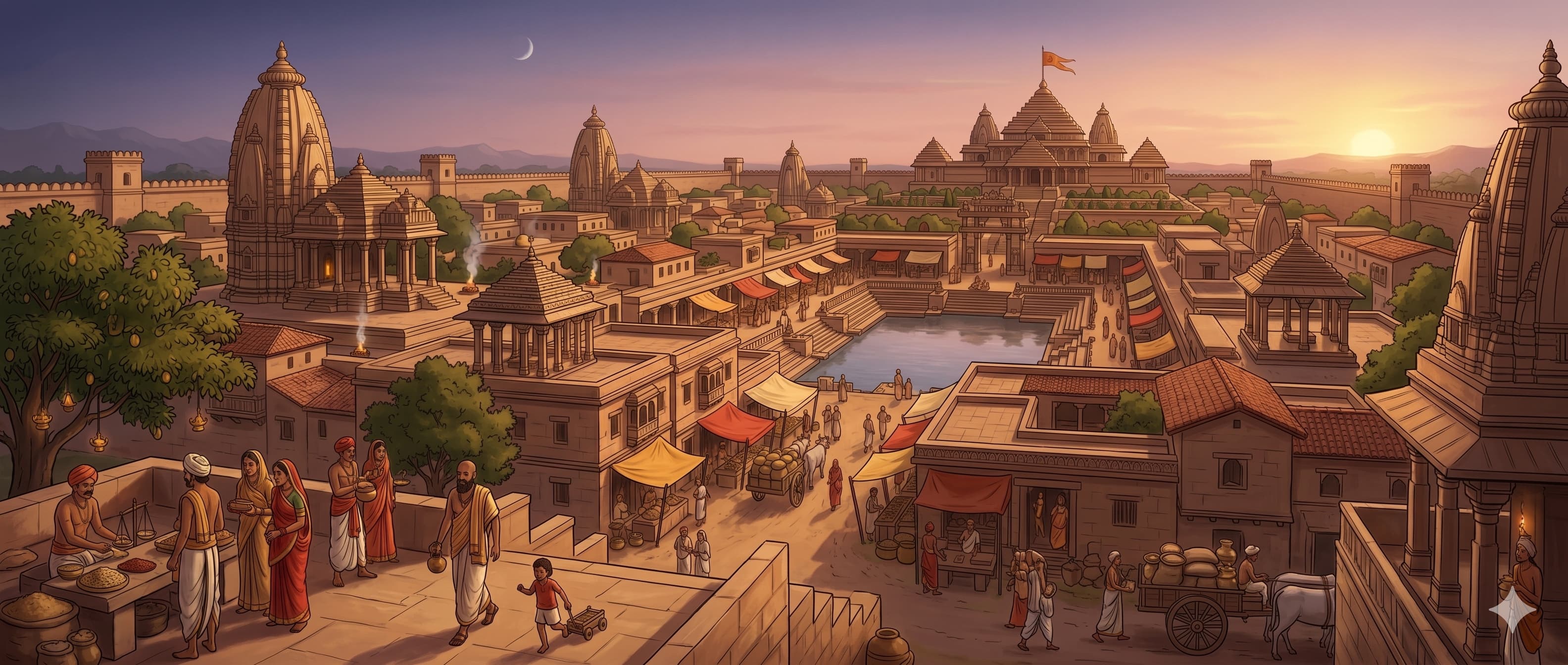
Where it begins · Agroha
Agroha at dusk — the prosperous Vaishya-Kshatriya capital founded by Maharaja Agrasen.
Founding Era
· स्थापना युगDvapara Yuga · TraditionalMaharaja Agrasen's reign, the Agroha kingdom, and the birth of the 18 gotras. Dates here come from oral tradition and the Agrasen Purana, not archaeological record.
Birth of Maharaja Agrasen
· महाराजा अग्रसेन का जन्मTraditional: ~3082 BCE· traditionPer Agrasen Purana, Maharaja Agrasen was born to King Vallabh of Pratapnagar in the late Dvapara Yuga. A Suryavanshi (Solar dynasty) Kshatriya by birth, he is the legendary forefather of the entire Aggarwal community.
Founding of Agroha
· अग्रोहा की स्थापनाTraditional· traditionAgrasen established the kingdom of Agroha in present-day Hisar, Haryana — built explicitly as a city of trade rather than conquest. Adopting Vanika dharma over the Kshatriya tradition, he turned the kingdom toward commerce, equality, and non-violence.
The 18 Yajnas — Birth of the Gotras
· १८ यज्ञ — गोत्रों का जन्मTraditional· traditionTo divide his descendants into distinct lineages, Agrasen performed Yajnas with 18 different Rishis presiding. Each son adopted the presiding Rishi's name as his gotra — establishing Garg, Goyal, Bansal, Mittal, and the rest. During the 18th Yajna, seeing the sacrificial horse's distress, Agrasen halted the ritual in compassion — choosing ahimsa over orthodoxy. The resulting Goyan lineage was, for centuries, referred to as a "half gotra" (17.5); at its 1983 National Convention in New Delhi (under Shri Ramdas Agarwal's leadership), the Akhil Bharatiya Aggarwal Sammelan formally ratified Goyan as the eighteenth whole gotra, ending the "half" framing and ensuring absolute equality across all lineages.
"Ek Iint, Ek Rupaya" — One Brick, One Rupee
· एक ईंट, एक रुपयाTraditional· traditionAgrasen's founding social principle: any insolvent newcomer to Agroha would receive one brick and one rupee from each existing citizen, so that within a single day they could build a home and start a business. The principle — radical mutual support — remains the community's defining ethic to this day.
Agrasen's 108-year reign
· अग्रसेन का १०८ वर्ष का राज्यकालTraditional: 108 years· traditionAccording to tradition, Agrasen ruled for 108 years — long enough to see his system of trade-centric, mutually-supporting communities flourish across Khandavprasth (modern Delhi), Ballabhgarh, and the Agra Janapada. Agroha grew into a city of 100,000 trader families.
Medieval Dispersal
· मध्यकालीन प्रवास~1000 – 1700 CEThe fall of Agroha during Shahabuddin Ghori's invasion, dispersal of the community across northern India, and the establishment of Aggarwal merchant networks under regional kingdoms.
The Fall of Agroha
· अग्रोहा का पतन1194 CEAgroha was devastated during Muhammad of Ghor's (Shahabuddin Ghori's) invasion in 1194 CE. The kingdom that had been the community's seat for millennia was largely destroyed. Survivors began dispersing across northern India.
Dispersal: Punjab, Rajasthan, UP, Malwa
· प्रवास — पंजाब, राजस्थान, उत्तर प्रदेश, मालवा13th – 16th c.Communities from Agroha migrated outward into present-day Punjab, Rajasthan, Uttar Pradesh, and the Malwa region. The community name 'Aggarwal' (literally 'people of Agroha') was preserved through these centuries of dispersal.
Pre-Independence
· स्वतंत्रता पूर्व1700s – 1946Rise of Aggarwal trading houses across British India. First professionals — lawyers, doctors, engineers. Participation in the freedom movement.
Aggarwal merchant houses across British India
· व्यापारी घराने18th – 19th c.Aggarwal trading families established powerful commercial houses across Calcutta, Mumbai, Delhi, and the princely states — handling cloth, grain, moneylending, and the foundations of modern Indian banking.
First professional generation
· पहली पेशेवर पीढ़ीEarly 1900sEducation spread through the community: the first generations of Aggarwal lawyers, doctors, and engineers emerged, often educated at Lahore, Calcutta, and Bombay. Trade remained the backbone alongside the new professions.
Aggarwals in the freedom movement
· स्वतंत्रता संग्राम1900 – 1947Aggarwal community members participated across the spectrum of India's freedom struggle — funding institutions, joining the Indian National Congress, the Civil Disobedience Movement, and Quit India. Several merchant houses funded national-school networks and swadeshi enterprises.
Lala Lajpat Rai — "Punjab Kesari"
· लाला लाजपत राय1865 – 1928Born to an Aggarwal family in Dhudike, Punjab, Lala Lajpat Rai became one of the most fierce voices of the Indian freedom movement — a central figure in the extremist wing of the Indian National Congress, an architect of the Swadeshi movement, and the founder of the Punjab National Bank. He died in 1928 from injuries sustained during a peaceful protest against the Simon Commission, after which Bhagat Singh and his comrades took up the cause of avenging him.
Jamnalal Bajaj — Gandhi's treasurer
· जमनालाल बजाज1889 – 1942A Marwari Aggarwal industrialist who renounced his colonial titles to join the freedom struggle. Bajaj became Mahatma Gandhi's closest confidant and the effective treasurer of the Indian National Congress, funding the Khadi movement, rural upliftment, and Gandhi's ashrams. Gandhi referred to him as his "fifth son." The Bajaj industrial conglomerate descends from his founding work.
Modern Era
· आधुनिक युग1947 – presentAggarwals across post-Independence India and the global diaspora. Industry, tech, finance, and the preservation of community ties across continents.
Independence and Partition
· स्वतंत्रता और विभाजन1947Many Aggarwal families crossed from West Punjab (Lahore, Karachi) into Independent India, often arriving with nothing. The community's mutual-aid tradition — Agrasen's 'Ek Iint, Ek Rupaya' in spirit — helped families rebuild within a generation.
Modern industry + the rise of Delhi
· आधुनिक उद्योग1950s – 1980sDelhi became the centre of Aggarwal commercial life in independent India. The community produced industrialists, chartered accountants, doctors, and engineers in increasing numbers, while continuing the trading tradition through wholesale markets like Chandni Chowk and Khari Baoli.
India Post commemorative stamp
· डाक टिकट24 Sept 1976On 24 September 1976, the Posts and Telegraphs Department of India issued a 25-paise commemorative stamp marking Maharaja Agrasen's 5100th birth anniversary. Printed in burnt-sienna ink by photogravure at the India Security Press, 8 million copies were released — featuring Agrasen's bust over an obverse-and-reverse illustration of ancient Janapada coins and a brick wall, a direct nod to the ASI excavations at the Agroha mound.
Agrohadham temple complex — original build
· अग्रोहाधाम — मूल निर्माण1976 – 1988Decision to build a central pilgrimage site for the global Aggarwal community was made in 1976 by the All India Aggarwal Representatives; the Agroha Vikas Trust was formed by Shri Krishna Modi, Rameshwar Das Gupta, and Sri Ram Kansal. The three original shrines were consecrated in 1984: Maa Adya Mahalakshmi (the universal Kuldevi, central shrine), Maharaja Agrasen (eastern shrine), and Maa Saraswati (western shrine). The complex's Shakti Sarovar — a sacred tank filled with water from 41 holy rivers of India, with a Samudra Manthan sculpture at its centre — was completed in 1988. Alongside the shrines sit a yagnashala with eighteen distinct yagna kundas (representing the eighteen gotras), dharamshalas for pilgrims, a museum, and the adjacent Maharaja Agrasen Medical College. The complex is currently being significantly expanded — see the separate 2021 Adya Mahalaxmi Temple and 2024-25 ASI heritage development entries.
The global Aggarwal diaspora
· वैश्विक प्रवास1990s – presentAggarwals are now established across the United States, Canada, United Kingdom, Australia, Singapore, and the UAE. Software, real estate, finance, and entrepreneurship dominate — but the community ties, samaj networks, and observance of gotra in marriage remain strong across continents.
New Adya Mahalaxmi Temple — under construction
· नया आद्य महालक्ष्मी मंदिर2021 – ongoingIn 2021 the Agroha Vikas Trust announced a major new temple at Agroha — a ₹100 crore Adya Mahalaxmi mandir dedicated specifically to the primordial form of the goddess, to stand 108 feet tall on a 10-acre site adjacent to the existing complex. The temple is being designed by the same Sompura architects who designed the Ayodhya Ram Janmabhoomi mandir. Together with the broader redevelopment of the Agrohadham complex underway, this represents the most significant expansion of the community's spiritual centre since the original shrines were consecrated in 1984.
ASI excavations + Heritage Tourism Circuit
· पुरातत्व उत्खनन2024 – 2025After a 44-year hiatus, the Archaeological Survey of India returned to the Agroha mound in March 2024 with Ground Penetrating Radar surveys conducted by an IIT Kanpur team, followed by deep-trench excavations. The 2025 dig (12 March – 31 May, directed by KA Kabui) uncovered a massive ancient platform with a brick wall. In October 2023 the Haryana government announced developing Agroha as a world heritage site on the lines of Rakhigarhi, signing an MoU with ASI. Planned new infrastructure includes a tourist welcome centre, site museum, planetarium, and knowledge park. In March 2025, Union Home Minister Amit Shah unveiled a grand statue of Maharaja Agrasen. The Hisar-Agroha Metropolitan Development Authority (HAMDA) is now preparing a master plan for Agroha as a global heritage city within a 25 km radius.
Agrasen Jayanti — celebrated globally
· अग्रसेन जयंतीEvery yearMaharaja Agrasen Jayanti is celebrated by Aggarwal samajs across India and the diaspora every Ashwin Shukla Pratipada (the first day of the Navratri month, typically September–October). Schools, hospitals, and charitable institutions named for Agrasen serve communities far beyond the Aggarwal fold.
Your family timeline · आपका परिवार
This is the community story. Your family has one too.
The Aggarwal Heritage lets each family document its own timeline — births, marriages, migrations, milestones — placed against this community backdrop.
Sign in to view your family