Guidance First · पहले मार्गदर्शन
Rituals & Festivals
संस्कार एवं त्योहार
Step-by-step guides with required items, mantras with meaning, and video walkthroughs for every occasion in the Aggarwal calendar. Each ritual is being documented carefully — with regional variations respected and the elders consulted.
 Major Festival
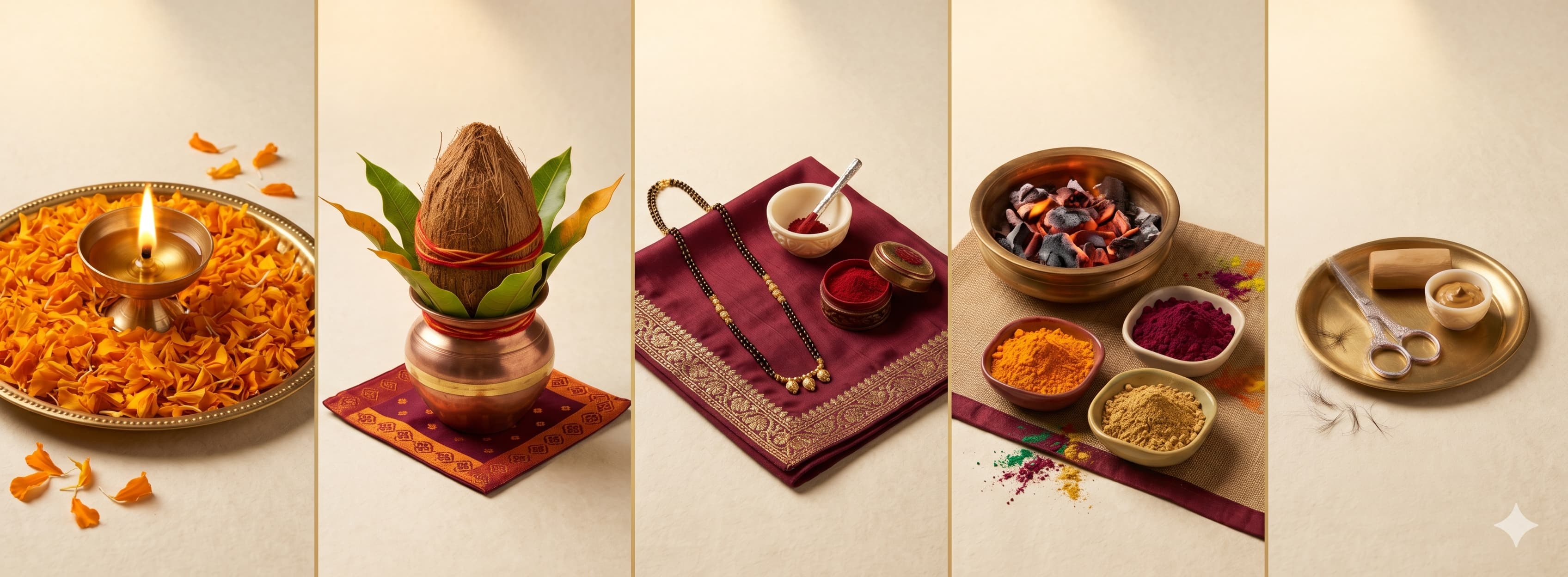
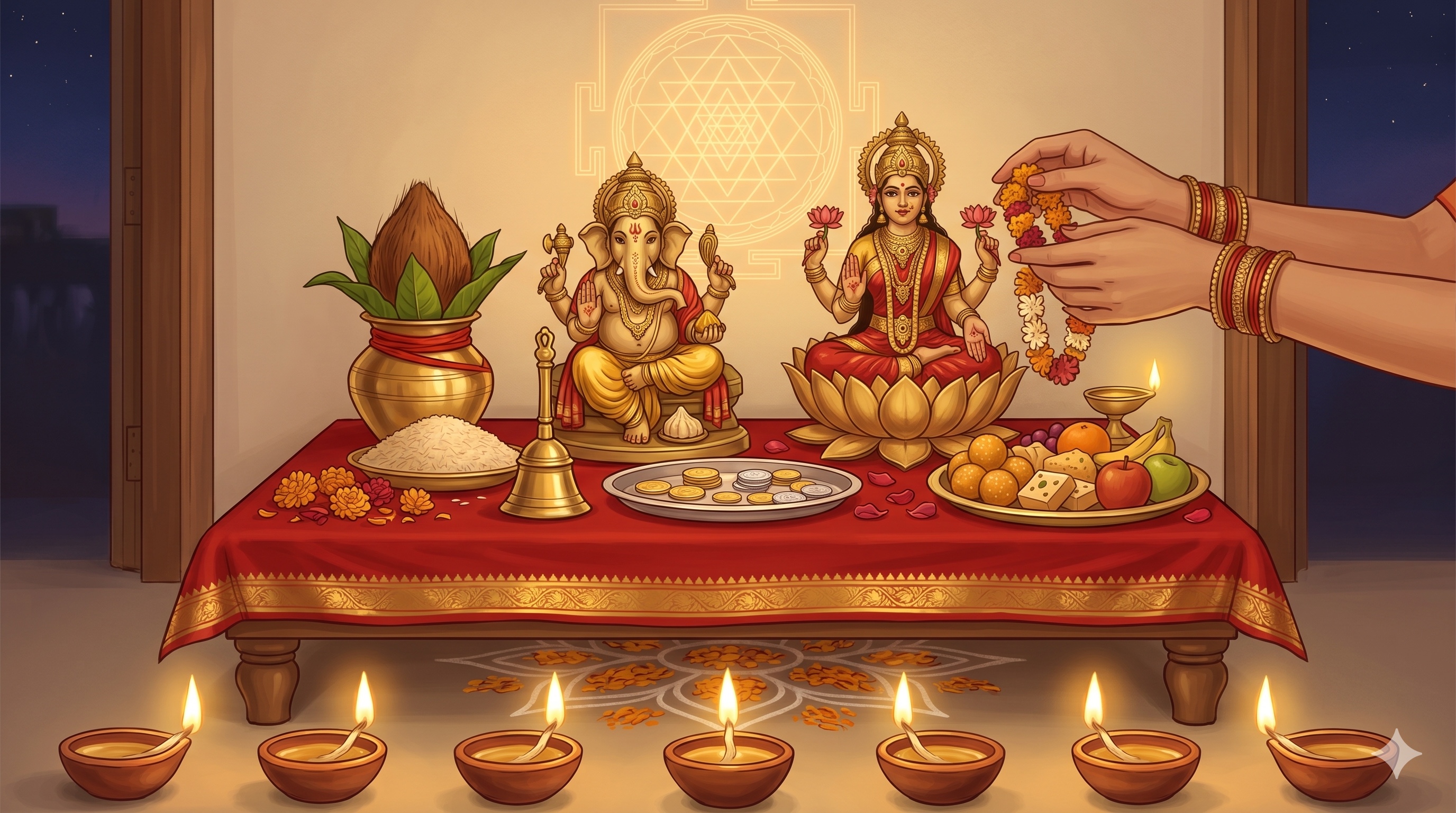
Diwali — Lakshmi Pooja
दीपावली — लक्ष्मी पूजा
Complete guide to Lakshmi-Ganesh pooja, lighting diyas, reciting Lakshmi Aarti, and the correct sequence on Diwali night.
Step-by-step
· विधि- 1Clean the home thoroughly during the day; sprinkle a little Gangajal in each room to purify the space.
- 2Bathe and wear fresh clothes, ideally red or other auspicious colours.
- 3Just after sunset (Pradosh Kaal), place a red cloth on the chowki where the puja will be performed.
- 4Set the idols of Goddess Lakshmi and Lord Ganesha — Ganesha to the left of Lakshmi.
- 5Set up the Kalash: a copper or brass pot filled with water, five mango leaves around the rim, a coconut placed on top.
- 6Light a diya, agarbatti, and dhoop in front of the deities.
- 7Begin with Ganesha worship — chant Om Gan Ganapataye Namah while offering flowers and akshat.
- 8Invoke Goddess Lakshmi by sprinkling holy water on her idol while chanting Om Shreem Mahalakshmiyei Namaha.
- 9Offer flowers (lotus is ideal), fruits, sweets, betel leaves, and kumkum to both deities.
- 10Recite the Lakshmi Aarti with devotion — ring the bell or clap during the aarti.
- 11Light additional diyas around the house, especially at the main entrance and in the kitchen.
- 12Distribute the prasad among family members.
Required items
· सामग्री- Red cloth for the chowki
- Idols of Lakshmi and Ganesha
- Copper or brass Kalash
- Five mango leaves and a whole coconut
- Diya, ghee, and cotton wicks
- Agarbatti and dhoop
- Fresh flowers (lotus or marigold)
- Akshat (unbroken rice)
- Kumkum, haldi, chandan
- Sweets and fruits for offering
- Betel leaves and supari
- A few coins or a small idol of Kuber
Mantras
· मंत्रॐ गं गणपतये नमः
Salutations to Lord Ganesha, remover of obstacles. Recited at the start of every puja to clear hindrances.
ॐ श्रीं महालक्ष्म्यै नमः
Salutations to Mahalakshmi, the source of wealth, abundance, and grace.
ॐ नमो भगवते वासुदेवाय
Salutations to Lord Vishnu, Lakshmi's eternal consort and the protector of the universe.
 Life Event
Griha Pravesh
गृह प्रवेश
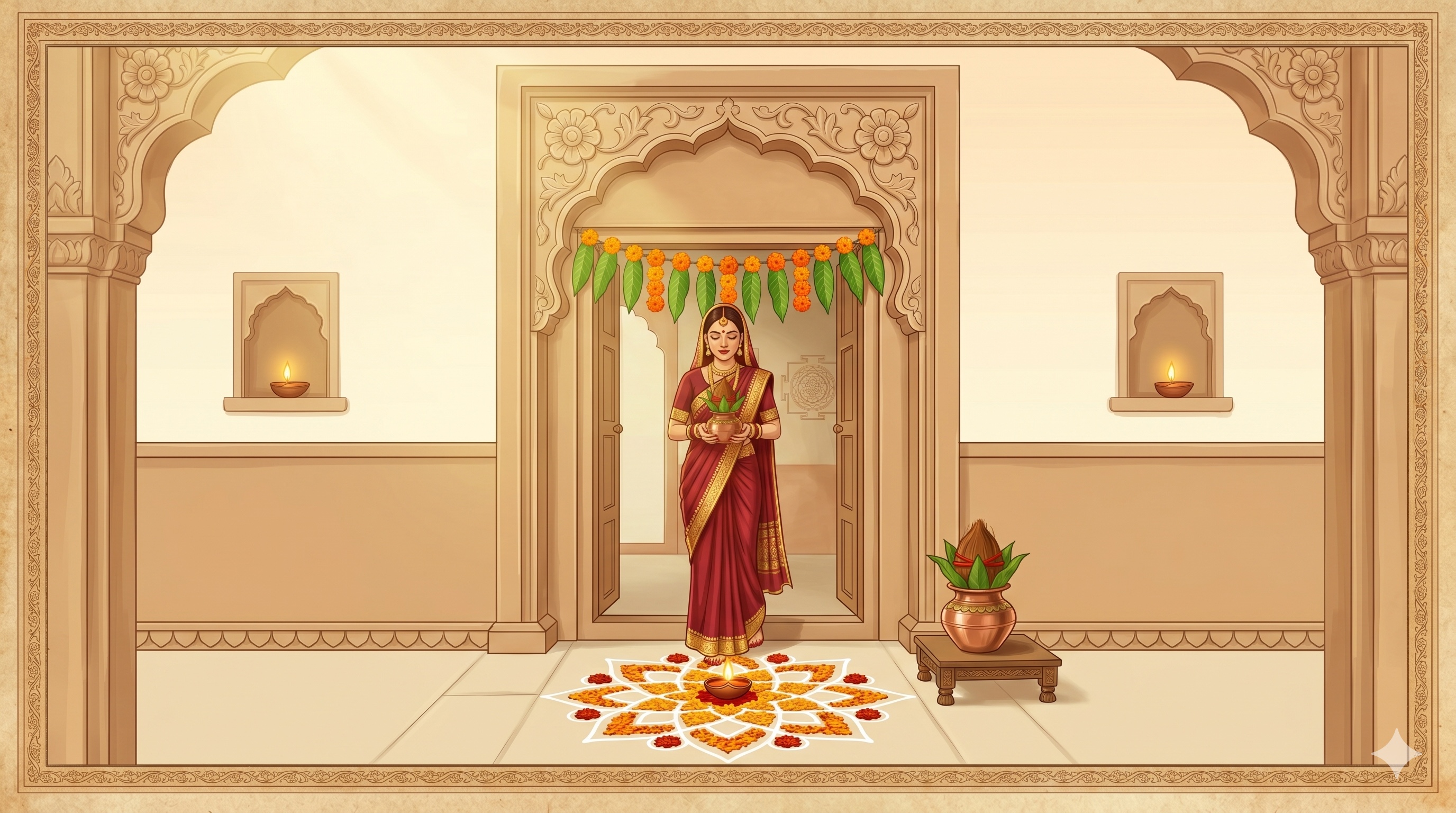
Moving into a new home the Aggarwal way — Vastu Pooja, Kalash Sthapana, Navgraha Shanti, and the auspicious entry with right foot.
Step-by-step
· विधि- 1Choose an auspicious day and muhurat in consultation with a Pandit or the Panchang.
- 2Clean the new home thoroughly; decorate the entrance with a mango-leaves toran and a fresh rangoli.
- 3Smear the threshold with haldi and kumkum; draw a Swastika on the main door.
- 4Set up the puja area with idols or pictures of Ganesha, Lakshmi, and the family kuldevta.
- 5Wife enters first, carrying a Kalash filled with water, raw rice, and a coconut on top — both partners step in with the right foot.
- 6Begin the puja with Ganesha worship to remove obstacles; recite the family Sankalp naming the gotra and intention.
- 7Perform Kalash Sthapana — copper or brass pot with water, rice, turmeric, mango leaves, and a coconut.
- 8Conduct the Vastu Shanti Havan to pacify the directional deities and the nine grahas.
- 9Sprinkle Kalash water in every room as you walk through the house.
- 10Light the kitchen stove for the first time and boil milk till it overflows — a symbol of prosperity.
- 11Cook the first meal (kheer is traditional) and offer it to the deity, then share among the family.
- 12Ensure someone stays in the house overnight after the puja — the home should not be left empty.
Required items
· सामग्री- Brass or copper Kalash
- Coconut and mango leaves (for kalash and toran)
- Raw rice (akshat), turmeric, kumkum, chandan
- Pictures or small idols of Ganesha, Lakshmi, and the kuldevta
- Diya, ghee, cotton wicks
- Agarbatti, dhoop, camphor
- Havan kund and havan samagri
- Sweets, fruits, and dakshina
- Milk for the first kitchen ritual
- Rice and dal for the first meal
- A new broom (auspicious in many families)
Mantras
· मंत्रॐ गं गणपतये नमः
Invocation of Ganesha at the threshold — so the new household begins without obstacles.
ॐ वास्तोष्पते प्रति जानीह्यस्मान् स्वावेशो अनमीवो भवा नः
Vastu Sukta: O Lord of the Dwelling, accept us and let this home be free of disease and full of well-being.
ॐ श्रीं ह्रीं श्रीं कमले कमलालये प्रसीद प्रसीद महालक्ष्म्यै नमः
Mahalakshmi mantra inviting abundance, grace, and prosperity into the new home.
 Marriage
Vivah Sanskar
विवाह संस्कार
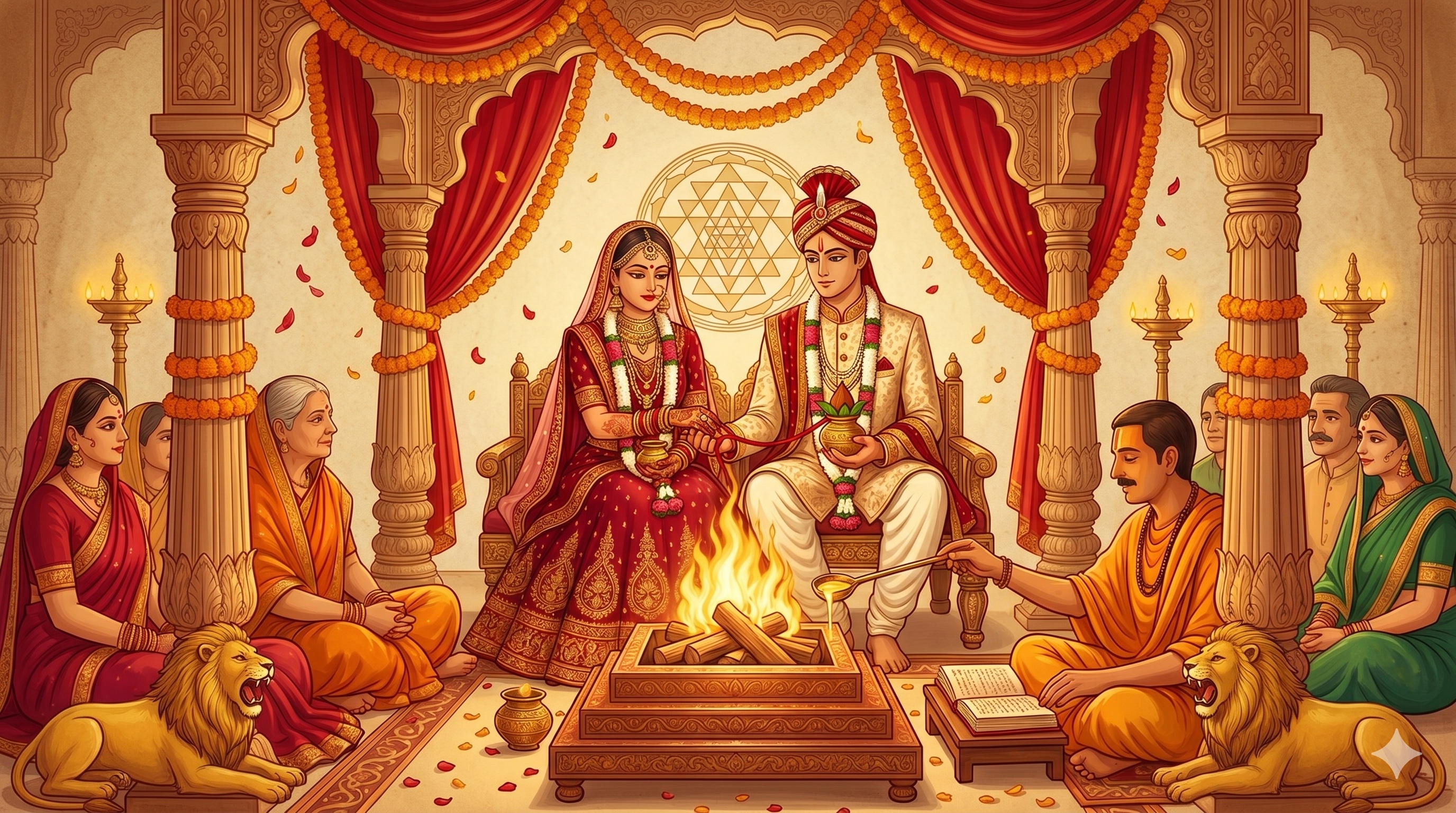
Complete Aggarwal wedding — from Sagai and Tilak to Saat Phere and Vidai, with meanings, mantras, and regional variations noted.
Step-by-step
· विधि- 1Tilak / Sagai — formal engagement; the bride's family applies tilak to the groom and exchanges gifts.
- 2Haldi ceremony — turmeric paste is applied to both bride and groom at their homes for purification.
- 3Mehndi and Sangeet — celebratory evenings of henna and music before the wedding day.
- 4Baraat arrives at the venue; the groom is welcomed by the bride's family at the Milni.
- 5Var Mala (Jaimala) — bride and groom exchange flower garlands, signifying acceptance.
- 6Kanyadan — the bride's father places her hand in the groom's, formally giving her in marriage.
- 7Panigrahan — the groom takes the bride's right hand, reciting the mantra of acceptance and commitment.
- 8Shilarohan — the bride steps on a small stone, symbolising her unwavering commitment.
- 9Laja Homa — the bride's brother pours puffed rice (laja) into her hands; the couple offers it together to the sacred fire.
- 10Agni Parikrama (Saat Phere) — the couple circles the sacred fire seven times. The bride leads the first three rounds; the groom leads the remaining four.
- 11Sindoor Daan and Mangalsutra — the groom applies sindoor to the bride's hair parting and ties the mangalsutra around her neck.
- 12Saptapadi — the couple takes seven steps together, each step a vow for shared life: nourishment, strength, prosperity, happiness, progeny, health, and lifelong friendship.
- 13Ashirvad — the elders bless the couple with akshat and kumkum.
- 14Vidai — the bride departs with her husband's family, throwing handfuls of rice back over her shoulder as a parting gift to her parents' home.
Required items
· सामग्री- Mandap (four-pillared canopy) with agni kund and havan samagri
- Var mala (flower garlands) and the sehra for the groom
- Bride's wedding attire, mangalsutra, and sindoor
- Tilak and haldi paste
- Coconuts, rice, and dal for the laja homa
- A small stone slab for Shilarohan
- Kalash with water, mango leaves, and a coconut
- Diya, ghee, cotton wicks, camphor
- Mehndi, flowers, and sweets
- Dakshina envelopes for the priest
Mantras
· मंत्रॐ गं गणपतये नमः
Beginning the ceremony by invoking Ganesha — for an obstacle-free married life.
गृभ्णामि ते सौभगत्वाय हस्तं मया पत्या जरदष्टिर्यथासः
Panigrahan mantra: I take your hand for prosperity. May you live a long life with me as your husband.
सखा सप्तपदी भव
Saptapadi vow: With these seven steps we become friends — may we walk together through life.
 Festival
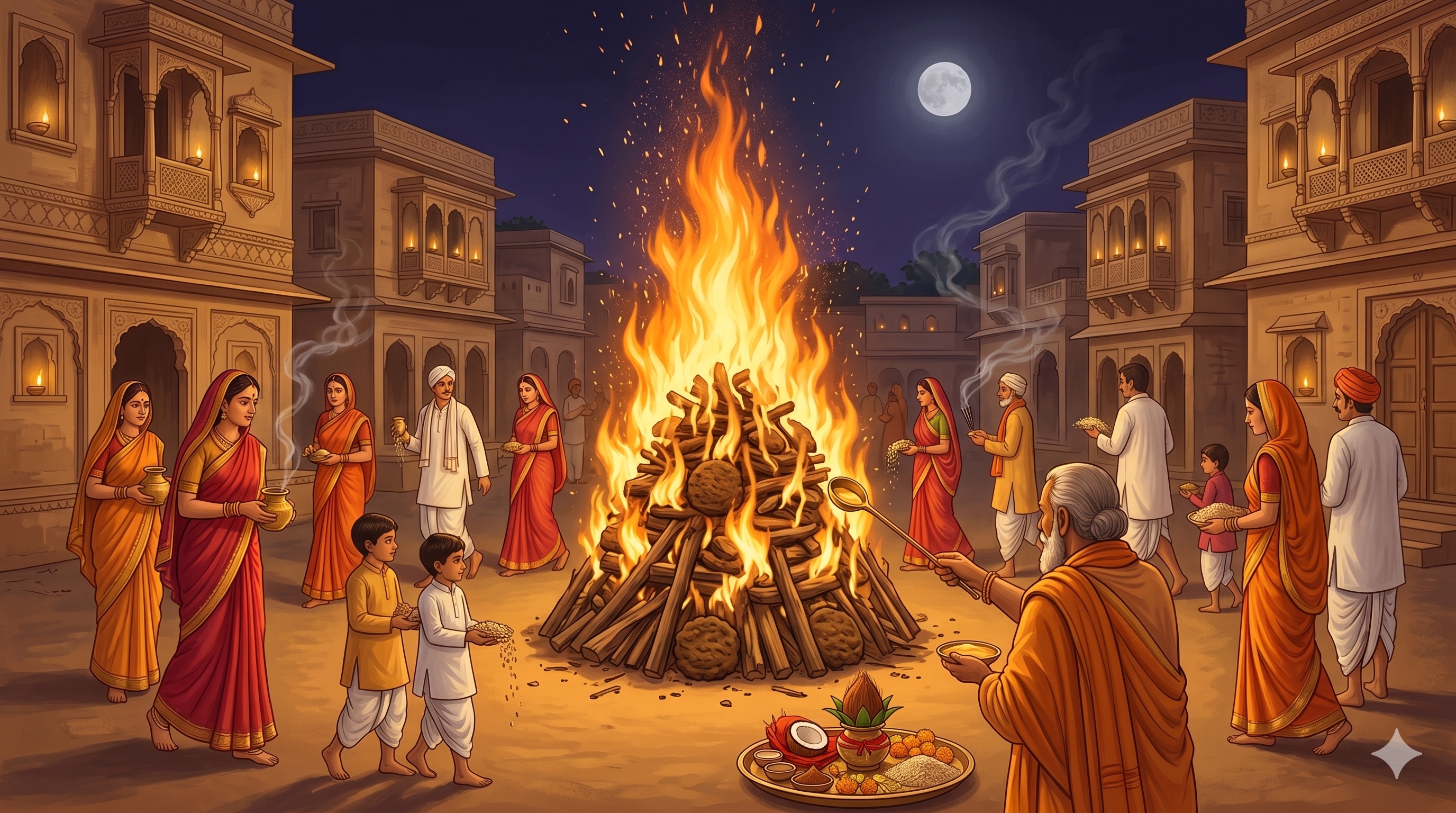
Holi — Holika Dahan
होली — होलिका दहन
Why we burn the Holika, the correct pooja before the bonfire, the significance of parikrama, and morning Rangwali Holi celebrations.
Step-by-step
· विधि- 1Build a small pyramid of wood, twigs, and dried cow-dung patties in an open space — traditionally done by the community.
- 2Bathe and wear clean (preferably new) clothes.
- 3Sit facing east or north before the unlit pyre.
- 4Purify yourself and the puja samagri by sprinkling water while chanting Om Pundarikakshah Punatu three times.
- 5Wrap raw cotton mauli thread around the wood pile three or seven times in the clockwise direction.
- 6Offer flowers, akshat, haldi-kumkum, and grains (wheat, gram, moong) to the pile.
- 7Add a coconut, batasha (sugar drops), and jaggery to be offered into the bonfire.
- 8Light the Holika pyre at the prescribed muhurat — after sunset on Purnima, once the Bhadra tithi has passed.
- 9Circumambulate (parikrama) the burning Holika four or seven times in the clockwise direction.
- 10Offer prayers to Lord Vishnu and Lord Narasimha, who protected the devotee Prahlad in this story.
- 11Roast newly harvested grains (wheat ears, gram) in the fire — eat them as prasad.
- 12The next morning, smear a little ash from the Holika onto the forehead, then play Rangwali Holi with colours.
Required items
· सामग्री- Dry wood, twigs, and dried cow-dung beads
- Raw cotton thread (mauli)
- Akshat (unbroken rice), turmeric, kumkum
- Fresh flowers
- Whole coconut
- Batasha (sugar drops) and jaggery
- Raw grains — wheat ears, moong, gram
- Diya, ghee, agarbatti
- A small bowl of water for purification
Mantras
· मंत्रॐ पुण्डरीकाक्षः पुनातु
Purification mantra: May the lotus-eyed Lord purify us. Recited three times before beginning.
ॐ नमो भगवते वासुदेवाय
Vishnu mantra recited 11, 21, or 108 times during the parikrama.
ॐ होलिकायै नमः सर्वपापक्षयाय नमः
Holika invocation: Salutations to Holika; may all our sins be destroyed in this fire.
ॐ नरसिंहाय नमः
Salutations to Lord Narasimha, the protector of devotee Prahlad — central to the Holika story.
 Child Ceremony
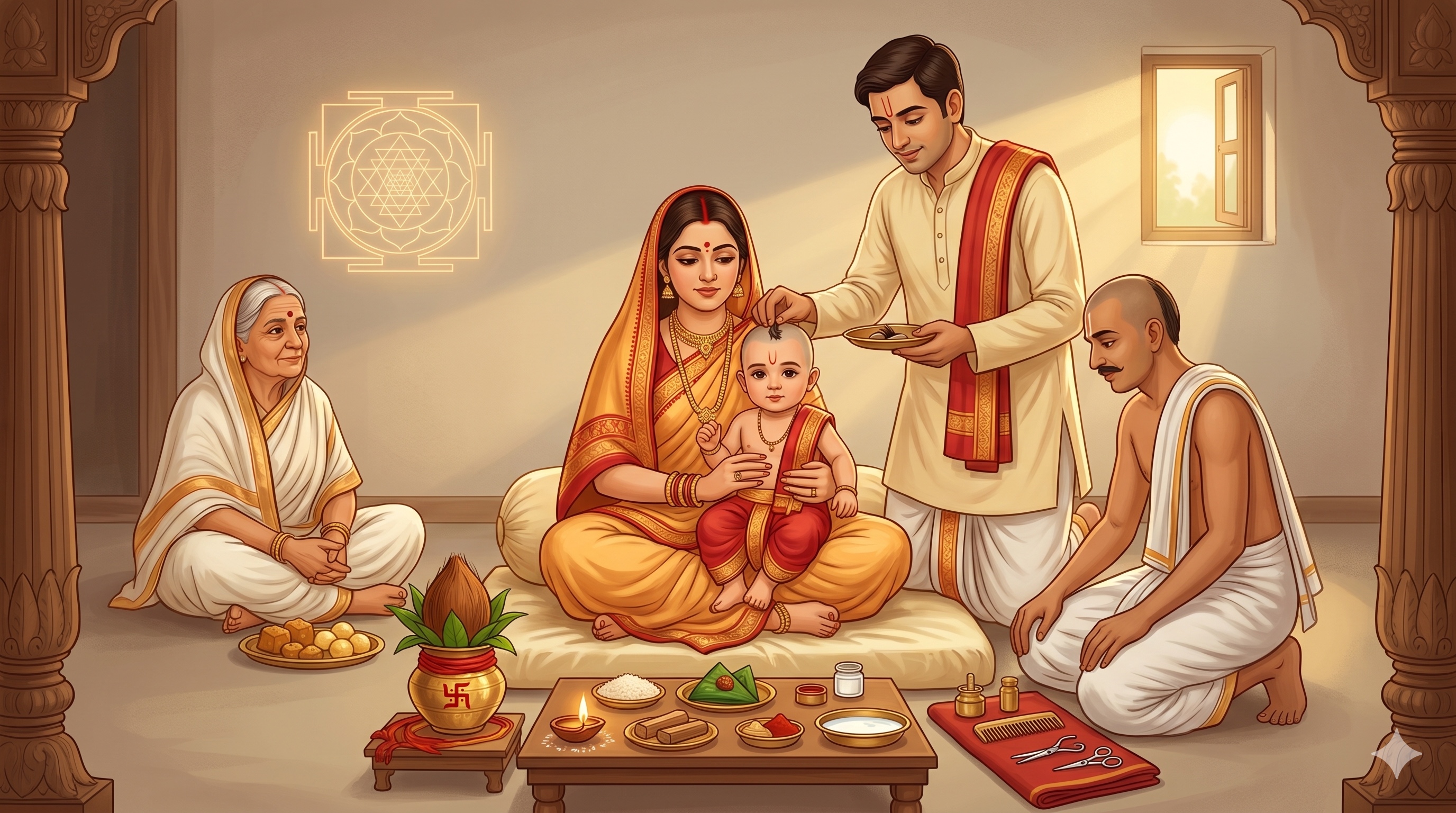
Mundan Sanskar
मुंडन संस्कार
One of the 16 Shodasha Samskaras — the first haircut. When to perform, what is needed, the mantras involved, and its spiritual significance.
Step-by-step
· विधि- 1Select an auspicious day with a Pandit's help — typically between 7 months and 3 years of the child's age.
- 2Bathe the child early in the morning and dress them in fresh new clothes.
- 3Begin the puja with Ganesha worship — the family Sankalp is recited naming the child, the gotra, and the parents.
- 4The child sits in the lap of an elder (often the mother or maternal grandparent), facing east.
- 5The priest chants the mundan sanskar mantras and ceremonially cuts the first few strands of hair from four sides of the child's head.
- 6The barber then carefully shaves the rest of the head clean.
- 7Wash the child's head gently with holy water (Gangajal) — said to soothe and bless.
- 8A small amount of turmeric paste or chandan is sometimes applied to the scalp.
- 9The shaved hair is collected and offered respectfully — given to a sacred river, buried at home, or as per the priest's instruction.
- 10Apply a tika of kumkum on the child's forehead.
- 11Elders bless the child with akshat, kumkum, and sweets.
- 12Share a feast or distribute prasad with family and close friends.
Required items
· सामग्री- New clothes for the child
- Holy water (Gangajal) for washing the head
- Diya, ghee, cotton wicks
- Akshat, kumkum, haldi, chandan
- Flowers for the puja
- Sweets and prasad for distribution
- A small bowl to collect the shaved hair
- Razor and scissors (used by the barber)
- Dakshina for the priest and the barber
Mantras
· मंत्रॐ गं गणपतये नमः
Ganesha invocation at the start of the ceremony — for the child's protected future.
आयुष्यं वर्चस्यं रायस्पोषमौद्भिदम्
May this rite bring the child long life, vigour, prosperity, and growth. Recited as the first strands are cut.
A living archive · जीवंत अभिलेख
This is a community-built archive. The full step-by-step guides, mantra audio, and video walkthroughs are being added one ritual at a time — checked against multiple Aggarwal families for regional accuracy. If you would like to contribute knowledge, recordings, or corrections, join the portal.