Shravan Purnima
Raksha Bandhan
रक्षा बंधन
A sister ties a rakhi on her brother's wrist and he pledges to look after her — and in our family the day also brings out the सोल (sol): paired protective figures we set at the place of worship and at every doorway to guard the home from evil. Kept on Shravan Purnima, the full moon.
When is it celebrated
· कबHindu calendar: Shravan Purnima — the full moon of Sawan
In 2026: Thursday, 27 August 2026
What this day means
· महत्त्वThe rakhi is the sister's blessing and the brother's promise to look after her. In our family the sol carry that same protection to every doorway, watching over the whole household.
What you'll need
· सामग्री| Item | If you're outside India |
|---|---|
| Rakhis | order online or post them ahead of time |
| Sweets / mithai | — |
| Joa — sweet dry seviyan (fine wheat vermicelli, ghee, milk, sugar, cardamom) | — |
| Sol — the paired protective figures, drawn or printed in red, always in pairs | print the template below, or draw them in red |
| Scotch tape, to put up the sol | — |
| A thali with roli, moli (sacred red thread) and rice | roli can be kumkum or sindoor from an Indian store |
| Ganesh ji | a small idol, a clay-and-moli Ganesh, or skip it |
| A glass or lota of water | — |
| Doob — fresh durva grass for the doorway sol | any fresh grass works |
Step-by-step
· विधि- 1Choose a clean spot — the puja room or your own room — mop it, and lay a mat or rug to sit on. Have the joa ready (a sweet dry seviyan: toast fine wheat vermicelli in ghee until golden, then cook with milk, water, sugar and cardamom until the liquid dries; rest covered a few minutes).
- 2Set up the thali: roli, moli (sacred red thread), rice, and Ganesh ji. No Ganesh idol? Shape a small mound of clay or soil into a round form and wind moli around it — that becomes Ganesh ji; and if you have neither, it is fine to go without.
- 3Put up the puja pair of sol on the wall with tape. Worship them: apply roli, moli and rice, offer a little joa, and sprinkle water on them. Run the moli from one figure's arm across to the other's, linking the pair.
- 4Everyone sits together. The sister applies a roli tilak on her brother's forehead with a few grains of rice, then ties the rakhi — men wear it on the right hand, women (and married women) on the left, either directly or on the hanging lumba that loops onto the bangles.
- 5The sister feeds her brother a sweet, and the brother gives her a gift.
- 6Take the remaining sol to every entrance of the home — one figure on each side of each doorway — and tape them up. Worship them the same way: roli on them, roli across their arms, a little rice, and place a touch of doob (fresh grass) on their 'mouth.'
- 7Finally, with the water from the glass or lota, touch or sprinkle the door frame on both sides. That completes the day.
The story
· कथाNo katha — the tilak, the rakhi and the sol are the heart of the day.
Printable
· छपाई
Sol — the protective figures
Print, then use in pairs: one pair at the place of worship, and one figure on each side of every doorway.
Download to print →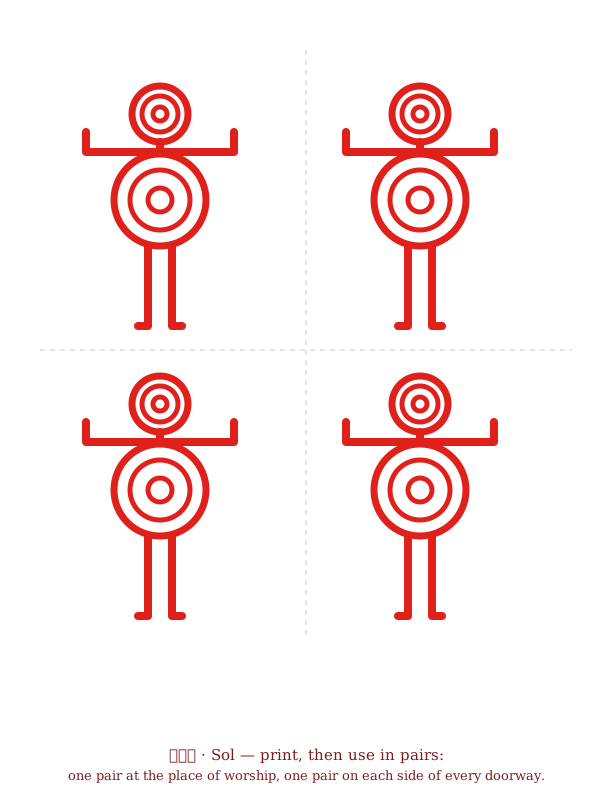
When to pause & things to keep in mind
These are traditional customs many families keep. Views differ today, and your health and your intention always come first — none of this is a rule.
- Monthly period. Many women rest from active worship and the ritual kitchen during their period — commonly the first three days — and resume after a bath. Often a senior woman of the house carries out the steps, or one simply holds the intention and keeps it when able.
- Sutak — after a birth or a death in the family. Worship is usually paused for a mourning period and resumed after it ends, with a cleansing bath. The length varies by community, so follow your family's count.
- Pregnancy. Ease strict fasts and strenuous steps — keep a lighter version, eat and drink as needed, or have someone else carry out the steps.
- Illness. It is completely fine to pause a fast or do a simpler puja when you are unwell. Recover first.
This guide is documented with regional variations respected and the elders consulted. Customs vary by family and region.